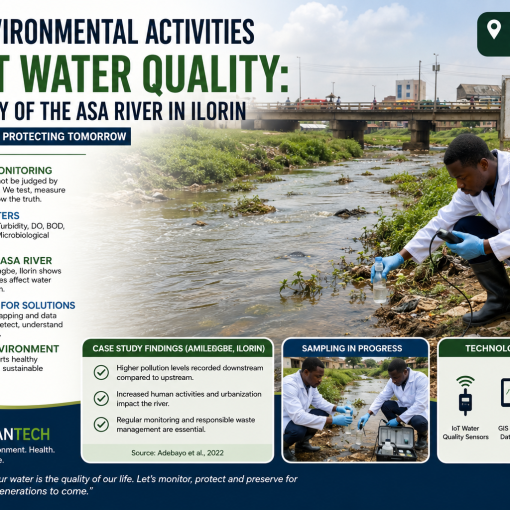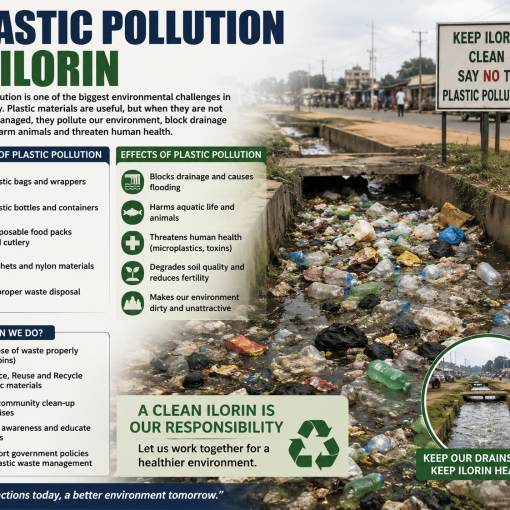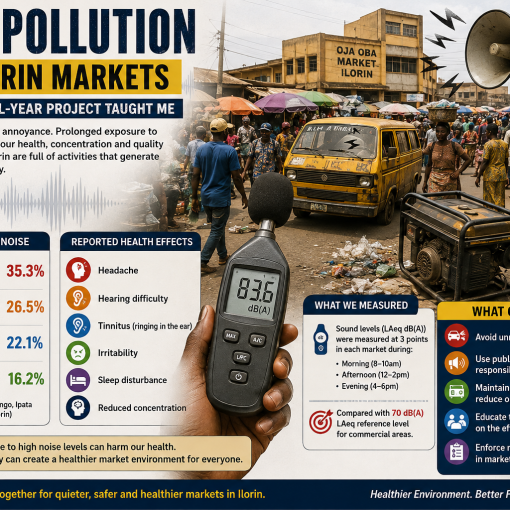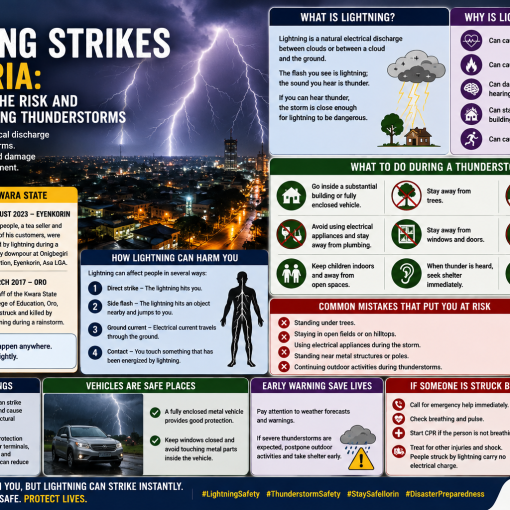
When we talk about solid waste management, it is easy to think that the job ends when a waste truck carries rubbish away from a street or market. In reality, that is only one stage of a much longer process.
The waste has to go somewhere.
In Ilorin, Kwara State, dumpsites have become an important part of this process. They are places where large quantities of municipal waste are brought together, but they are also places where another activity takes place: scavenging and recovery of materials that still have economic value.
Plastic bottles, metals, cartons and other materials that people consider useless can become sources of income for scavengers and raw materials for recycling businesses.
The problem is that much of this recovery takes place in an environment that can expose workers to significant health and safety risks.
What Happens to Waste After Collection?
Research on municipal solid waste in Ilorin has identified a mixture of materials including food residues, plastics, sachet water nylon, cartons, paper, metals, rubber, leather, wood and other organic materials (Ibikunle et al., 2022).
Ideally, these materials should not all follow the same route.
Some can be reused. Some can be recycled. Organic materials can potentially be composted or otherwise recovered. Other materials may require controlled disposal.
However, Ilorin’s waste-management system has historically relied heavily on collection and disposal. Research has described the use of skips and RORO bins before transportation to dumpsites, alongside illegal and unscientific disposal at undesignated locations (Ibikunle et al., 2022).
This creates a problem because valuable materials become mixed with materials that may be hazardous.
Once everything is mixed together, recovering recyclable materials becomes more difficult and more dangerous.
The Scavengers at Sokoto-Aiyekale
A particularly useful case study comes from research conducted among waste scavengers in Ilorin.
A 2023 study assessed occupational risks among scavengers working in the metropolis. The researchers surveyed more than 100 scavengers and conducted field observations at the government dumpsite at Sokoto-Aiyekale. The researchers observed scavengers searching through mixed waste for recyclable materials (Raufu et al., 2023).
This activity provides an important environmental service, even though it is largely informal.
Scavengers recover materials that would otherwise remain buried or mixed with other waste. Those materials can then enter recycling and reuse markets.
An earlier study specifically examining waste scavenging in Ilorin concluded that scavengers could potentially be incorporated formally into the recycling process. Using plastic waste as an example, the researchers found that recycling through scavenging could be economically viable (Adeyemi et al., 2001).
So the question should not simply be whether scavenging is good or bad.
A better question is:
How can the useful part of scavenging be retained while reducing the risks associated with it?
The Health Risks Are Real
Scavenging is physically demanding work, and the conditions at dumpsites can expose workers to numerous hazards.
The Ilorin occupational-risk study reported that 84.5% of respondents had never received training in waste handling and occupational safety procedures (Raufu et al., 2023).
The study also found that 76.4% reported burning waste, while 70% reported inhaling smoke. Injuries were another concern: 75.5% said they sometimes sustained injuries while scavenging, while 18.2% reported injuries occurring always (Raufu et al., 2023).
These figures demonstrate why scavenging should be considered an occupational-health issue.
A person searching through mixed waste may encounter broken glass, sharp metals, contaminated materials, chemicals or other hazardous objects.
There is also a biological risk.
Research among scavengers and municipal waste workers in Ilorin investigated hepatitis B infection and occupational exposure. The researchers highlighted injuries from sharps and contact with discarded materials as potential routes of exposure (Abdullahi et al., 2018).
This is why personal protective equipment, vaccination where appropriate, training, safer sorting systems and access to healthcare should be part of any attempt to formalize waste recovery.
What Is Working?
It would be wrong to say that nothing works in Ilorin’s waste-management system.
There are designated collection systems, waste containers, government dumpsites, commercial waste collectors and people actively recovering recyclable materials.
Research among selected Ilorin markets found that 75.4% of traders emptied their waste into public stationary containers, while waste collection was commonly carried out every couple of days (Ola et al., 2020).
Government enforcement has also produced measurable improvements. In August 2024, the Kwara State Government reported that its enforcement exercise had achieved about 70% compliance in the early days of the campaign and that many streets previously affected by roadside debris had improved (Kwara State Government, 2024).
The state also established an environmental task force and directed registered scavengers to operate at the government dumpsite rather than moving around the metropolis (Kwara State Government, 2024).
These measures show that enforcement and organized collection can influence public behaviour.
What Is Not Working?
The biggest weakness is that much of the system still operates after waste has already become mixed.
When food waste, plastics, metals, sanitary materials and other materials are placed together, recovering recyclables becomes harder and creates additional risks for anyone sorting through them.
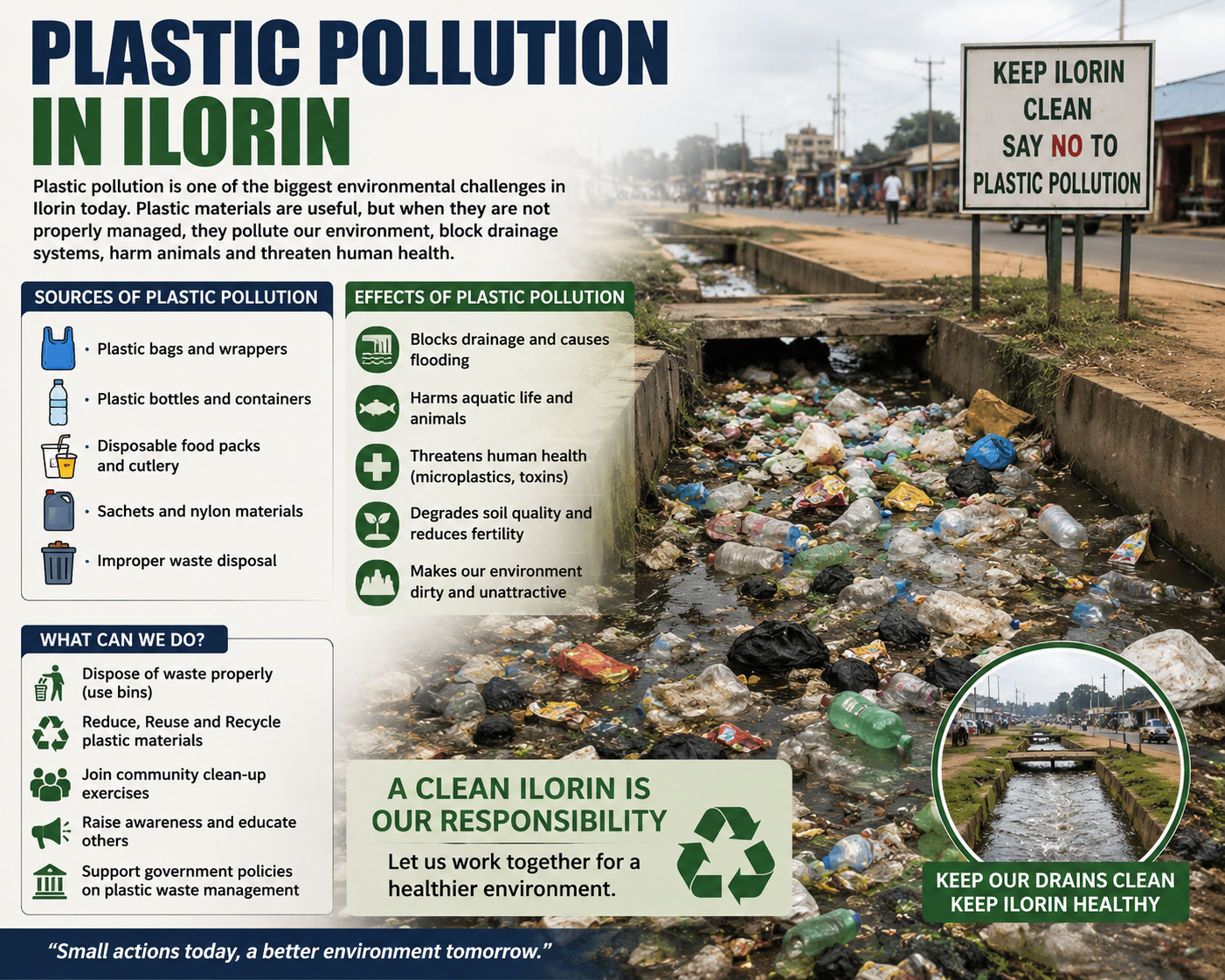
Research on Ilorin has also documented illegal dumping and disposal at places such as drainages, markets, rivers and uncompleted buildings (Sakariyau, 2019).
A 2026 report from the Kwara State Government illustrates that the problem has not disappeared. The state warned against illegal dumping along the Airport Road axis in Ilorin, despite the provision of four large RORO bins in the area (Kwara State Government, 2026).
This shows that providing infrastructure alone does not guarantee proper waste disposal.
There must also be reliable collection, enforcement, public cooperation and convenient disposal options.
Recycling Should Start Before the Dumpsite
One of the most important improvements would be source separation.
Imagine a household having separate containers for food waste, plastics, metals, paper and other residual waste. Recyclable materials could then be collected separately rather than being buried under mixed rubbish.
This would make recycling safer and potentially more profitable.
It would also reduce the amount of material requiring final disposal.
The concept is consistent with the circular-economy approach, where materials are kept in use for as long as possible instead of being treated simply as waste.
In June 2026, Professor Adeniyi Saheed Aremu of the University of Ilorin called for an integrated smart waste-management system that includes smart bins, recycling, material-recovery facilities, waste-to-energy systems, sanitary landfills, transfer stations and improved collection vehicles (University of Ilorin, 2026).
That is a significant shift in thinking.
Instead of asking, “Where can we dump this?”, the question becomes, “What can we recover from this?”
The Role of Technology
Environmental sanitation technology can improve almost every stage of this process.
GPS and GIS can help map illegal dumping locations and identify areas with inadequate collection services. Smart bins can provide information about when containers need emptying. Digital platforms can help monitor collection routes.
At the dumpsite, material-recovery facilities could provide safer and more organized sorting environments than searching manually through mixed waste.
Waste characterization can also help authorities understand exactly what is entering the waste stream.
Research on Ilorin has already examined the quantity and composition of municipal waste and its potential energy value, showing that part of the waste stream could potentially contribute to energy generation rather than simply being discarded (Ibikunle et al., 2021).
What Environmental Health Adds
My Environmental Health Science training has taught me that waste management is not only an engineering problem.
It is also an occupational-health, public-health and behavioural issue.
The question is not simply whether waste disappears from the street. We need to know where it goes, who handles it, what hazards they face and what happens to the environment afterward.
My academic work, practical exposure and SIWES experience at RUWASSA have reinforced this way of thinking. Environmental health requires looking at the entire chain rather than focusing on only one part.
The late Professor Henry Sawyer was also among the lecturers who contributed to my academic foundation and understanding of environmental health as a discipline that connects environmental conditions with human health.
Conclusion
Ilorin’s dumpsites tell two stories at the same time.
One is a story of a waste-management system that still struggles with illegal dumping, mixed waste and inadequate recovery.
The other is a story of opportunity.
Scavengers are already recovering valuable materials from the waste stream. Recycling is already happening informally. What is missing is a stronger system that can make this recovery safer, more organized and more efficient.
The solution is not simply to remove scavengers and replace them with nothing. Their knowledge of recyclable materials and their role in material recovery can be incorporated into a safer formal system.
Ilorin needs stronger source separation, organized material recovery, proper protective equipment, training, reliable collection, enforcement and investment in recycling infrastructure.
The future should not be a city where everything is collected only to become another pile of mixed waste.
It should be a system where waste is separated, materials are recovered, workers are protected, recyclable resources are returned to the economy and only unavoidable residues reach controlled disposal facilities.
That is how a dunghill can begin to become a resource—and how waste management can move from disposal toward genuine environmental sanitation technology.
References
Abdullahi, I. N., et al. (2018). Risk Factors and Rates of Hepatitis B Virus Infection among Municipal Waste Management Workers and Scavengers in Ilorin, Kwara State, Nigeria. BioMed Research International.
Adeyemi, A. S., Olorunfemi, J. F., & Adewoye, T. O. (2001). Waste scavenging in Third World cities: A case study in Ilorin, Nigeria. Environment Systems and Decisions, 21, 93–96.
Ibikunle, R. A., Titiladunayo, I. F., Dahunsi, S. O., Akeju, E. A., & Osueke, C. O. (2021). Characterization and projection of dry season municipal solid waste for energy production in Ilorin metropolis, Nigeria. Waste Management & Research, 39(8).
Ibikunle, R. A., et al. (2022). Exploration and prediction of wet season municipal solid waste for power generation in Ilorin metropolis, Nigeria. Scientific Reports.
Kwara State Government. (2024). Kwara Govt detects illegal dump site, arrests waste collector, police inspector for connivance.
Ola, A. B., Raheem, W. A., Raheem, W. M., & Ibrahim, R. (2020). Assessment of Solid Waste Management in Selected Markets in Ilorin, Nigeria. University of Ilorin .
Raufu, Y. O., Adewoye, S. O., Raimi, M. O., Sawyerr, H. O., & Oladimeji, L. O. (2023). Assessment of occupational risks of waste scavenging in Ilorin metropolis. AfricArXiv.
Sakariyau, B. (2019). Assessment of Solid Waste Disposal & Environmental Issues in Ilorin Metropolis. Journal for Studies in Management and Planning.
University of Ilorin. (2026, June 15). Aremu canvasses integrated waste management approach. University of Ilorin.