Plastic has become part of everyday Nigerian life. We use sachet-water bags, takeaway packs, shopping bags, bottles, food wrappers and other plastic products almost every day. They are cheap, lightweight and convenient, but the same qualities that make plastic useful also make it a serious environmental problem when it is poorly managed.
In Ilorin, plastic waste can be seen along roadsides, around markets, in open spaces and, sometimes, inside drainage channels. During my Environmental Health Science training at Kwara State University, I learnt that waste should not be considered only as something that needs to be removed from sight. Its source, composition, handling, disposal and possible effects on human health and the environment all have to be considered.
Plastic pollution is therefore not simply a matter of seeing a nylon bag on the street. It is a waste-management problem that can affect drainage, water, soil, air and the wider environment.
Why Plastic Has Become a Problem
Plastic is extremely durable. That durability is useful when we want a bottle, container or packaging material to last, but it becomes a disadvantage when the material is discarded carelessly.
A food wrapper used for a few minutes can remain in the environment for a very long time.
The problem becomes greater when large quantities of single-use plastics are generated without an equally effective system for collection, sorting, recycling and final disposal.
A 2024 study specifically investigated plastic-waste generation and management in Ilorin, focusing on Gaa-Akanbi and Tanke Oke-Odo. The researchers estimated average plastic-waste generation at 0.16 kg per person per day in Gaa-Akanbi and 0.29 kg per person per day in Tanke Oke-Odo (Oladipupo et al., 2024).
Those figures make the problem more concrete.
Plastic waste is not something generated somewhere far away. It is being generated within residential communities in Ilorin every day.
What We Are Taught in Environmental Health
One of the important principles I have learnt at KWASU is that environmental health is largely about prevention.
Rather than waiting for a problem to become a disaster, we identify the hazard and try to control it at its source.
Plastic waste provides a good example.
If a household separates plastic bottles from food waste before disposal, the bottles can potentially enter a recycling chain.
If everything is mixed together, recovering the recyclable materials becomes more difficult.
This is why waste segregation is important.
We also learn to consider the relationship between environmental hazards and their pathways. A plastic bottle thrown onto the ground may appear insignificant, but rainfall can move it into a drainage channel. The blocked drainage can then contribute to water accumulation during heavy rainfall.
The plastic itself has not “caused” the rainfall. Rather, poor waste management has created an additional environmental problem.
What I See Around Ilorin
As an Environmental Health Science student, field observation has made some of these lessons easier to understand.
You can walk through parts of Ilorin and see how quickly lightweight plastics accumulate where waste collection is inadequate or people dispose of waste indiscriminately.
The situation is particularly noticeable around busy areas where people buy food and drinks.
A bottle is purchased.
A sachet is opened.
A food pack is used.
The contents are consumed.
Then the packaging becomes waste.
The environmental problem begins when there is no convenient and reliable route for that waste to reach collection, recovery, recycling or proper disposal.
This is why environmental health cannot depend entirely on telling residents to “keep the environment clean.” There must also be systems that make responsible disposal possible.
Evidence from Ilorin
The 2024 Ilorin study provides an interesting picture of current plastic-management practices.
In the two residential areas studied, polyethylene was the dominant plastic category. Gaa-Akanbi recorded polyethylene at 57.05% of sampled plastic waste, while Tanke Oke-Odo recorded 56.28%. PET, polystyrene and polypropylene made up other significant portions (Oladipupo et al., 2024).
The researchers also found worrying disposal patterns.
Only 28% of respondents handed their waste to collectors, while 11% used municipal collection bins. Ten percent reported open dumping, while a much larger 51% reported burning their plastic waste (Oladipupo et al., 2024).
The burning of plastic is particularly concerning because solving one waste problem by creating another is not sustainable.
Burning plastic can release pollutants into the atmosphere, exposing people nearby to smoke and potentially harmful substances.
This also connects Article 19 to the air-pollution article discussed earlier.
The subjects are different, but environmental problems can interact.
Plastic and Drainage in Ilorin
One of the most obvious connections between plastic pollution and other environmental problems is drainage.
Plastic bags, bottles and food packaging are lightweight enough to be carried by wind and stormwater.
Once they enter drainage channels, they can accumulate with other materials.
The Kwara State Environmental Protection Agency has specifically warned residents against dumping refuse into drainage channels. In April 2025, KWEPA explained that blocked drainage can prevent the free flow of water and contribute to destruction of lives and property during rainfall (KWEPA, 2025).
This is important when discussing flooding.
Plastic pollution is not the same as flooding, and flooding has many causes. However, plastic waste can become part of the chain that makes drainage problems worse.
A responsible waste-management system therefore contributes to disaster-risk reduction as well as environmental cleanliness.
What Happens to Plastic After Disposal?
Ideally, plastic waste should not simply move from a house to a dump.
Some plastics can be collected, sorted, processed and used to manufacture new products.
This is the principle behind recycling and the broader idea of a circular economy.
The Ilorin study recommended a circular-economy approach involving waste reduction, recycling, reuse and better resource management (Oladipupo et al., 2024).
This approach changes the question from:
“How do we get rid of this plastic?”
to:
“How can we keep this material in useful circulation for as long as possible?”
That is a much better environmental question.
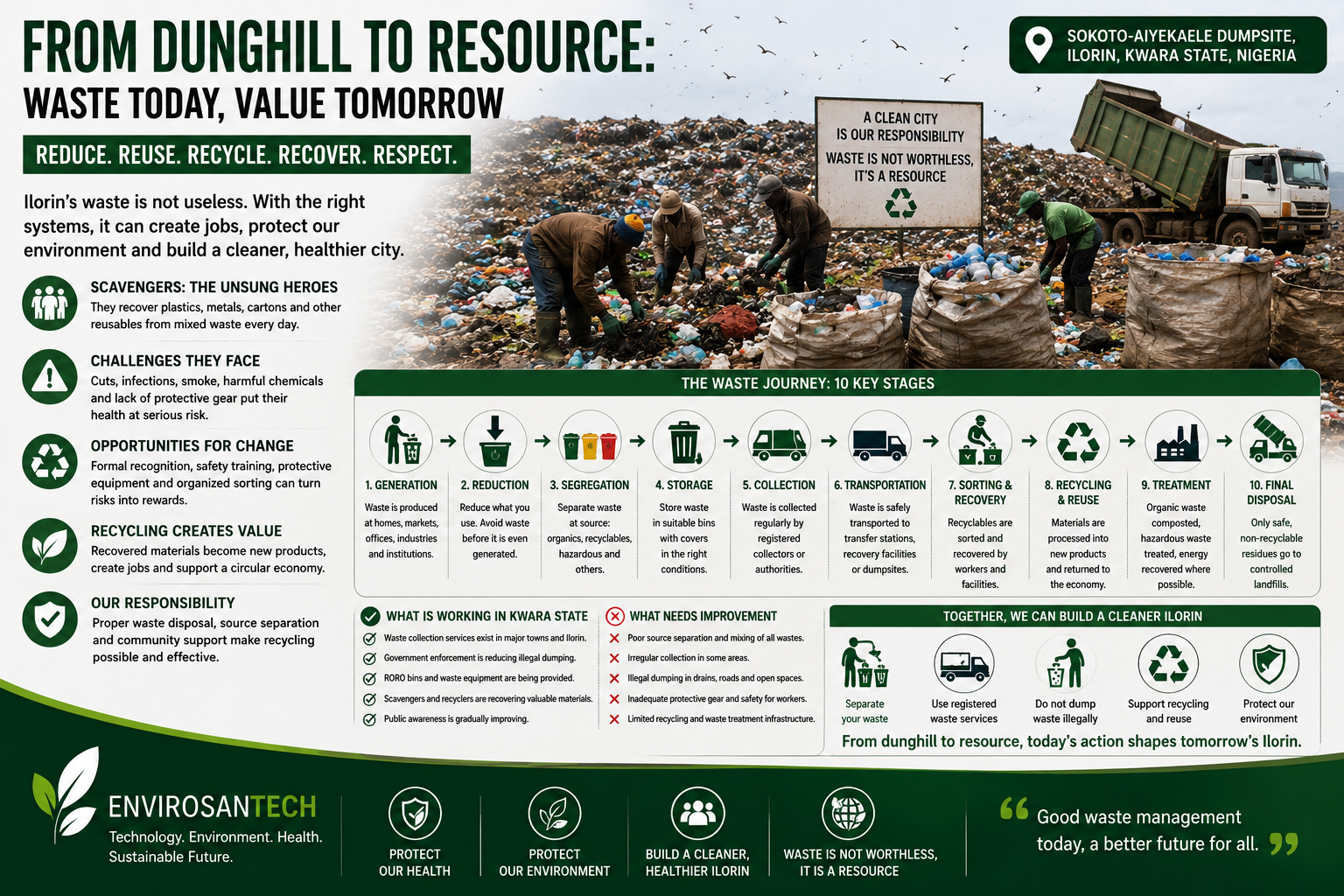
The Role of Scavengers and Waste Pickers
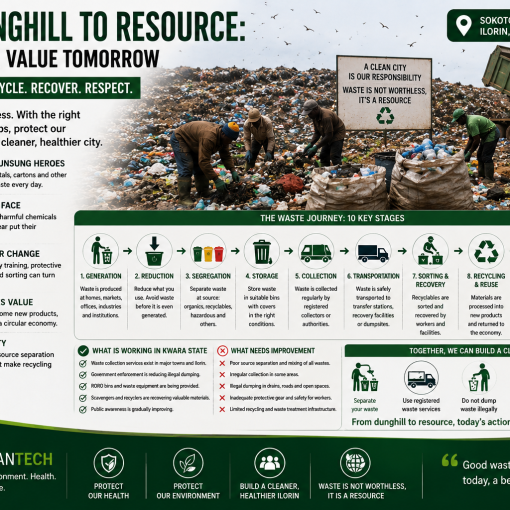
Waste pickers also play an important role in plastic recovery.
In Nigeria, informal waste workers often collect bottles, metals and other recyclable materials and sell them to aggregators or recycling businesses.
The World Bank notes that informal waste collectors and waste pickers play an important role in recovering recyclable materials in Nigeria, although the country’s recycling infrastructure is still insufficient to handle the volume of plastic waste being generated (World Bank, 2024).
This means that the people who collect recyclable materials from dumpsites and other locations should not simply be viewed as people searching through rubbish.
They are participating in a recovery system.
However, they may also face occupational hazards from sharp objects, contaminated waste and direct contact with potentially hazardous materials.
Environmental health should therefore consider their protection too.
What About Government and Producers?
Individuals cannot solve plastic pollution alone.
Government agencies have responsibilities for regulation, waste management, environmental monitoring and enforcement.
Producers also have a role.
Nigeria has been working toward Extended Producer Responsibility for plastic packaging, an approach under which producers can have responsibilities for the environmental management of their products after use. UNEP reported that it supported NESREA in developing guidelines for implementing Extended Producer Responsibility for plastic packaging in Nigeria (UNEP, 2024).
This is important because the responsibility for plastic should not rest entirely on the person who throws away the bottle.
The companies producing and placing large quantities of plastic packaging into the market should also be part of the solution.
What Can Residents Do?
There are practical steps that households can take.
First, reduce unnecessary single-use plastics where possible.
Second, reuse suitable containers rather than immediately throwing them away.
Third, separate recyclable plastics from other waste.
Fourth, give recyclable materials to appropriate collectors or recycling organisations where available.
Fifth, never use drainage channels as waste bins.
And importantly, avoid burning plastic waste.
The 2024 Ilorin study demonstrates that disposal behaviour remains a major challenge, with burning accounting for the largest reported disposal method among the surveyed households (Oladipupo et al., 2024).
Changing this behaviour will require both public education and better waste-collection systems.
From Classroom Lessons to Real Life
Environmental Health Science has taught me to look at environmental problems as connected systems.
The late Professor Henry Sawyer was among the lecturers who contributed to my academic foundation, and the preventive approach from our training continues to influence how I look at environmental conditions around me.
When I see a plastic bottle lying beside a road in Ilorin, I no longer see only litter.
I think about where it came from.
I think about where it could end up.
Could it enter a drain?
Could it reach a stream?
Could it be collected for recycling?
Could it be burned?
Could someone working at a dumpsite handle it without protective equipment?
These questions turn an ordinary piece of plastic into an environmental-health issue.
Conclusion
Plastic has made modern life more convenient, but convenience without responsible management creates environmental problems.
Evidence from Ilorin shows that plastic waste is being generated in significant quantities and that disposal practices remain a challenge.
The solution is not to pretend that plastic can disappear from our lives overnight.
Instead, Ilorin needs stronger waste segregation, reliable collection, increased recycling, public education, responsible consumer behaviour, protection for waste workers and effective implementation of producer-responsibility systems.
Most importantly, plastic should be treated as a resource that can often be recovered, rather than automatically treating it as useless rubbish.
The bottle lying beside the road may look worthless.
But if it is collected, sorted and recycled, it becomes something different.
It becomes a resource.
The goal should not simply be a cleaner street. It should be a system where less plastic becomes waste in the first place.
References
- Oladipupo, S. B., Ayanshola, A. M., Adeleye, A. T., & John, K. I. (2024). Assessment of plastic waste generation and management in residential locations, Ilorin, Nigeria: DPSIR analysis and circular economy pathway. Journal of Umm Al-Qura University for Applied Sciences, 10, 624–639.
- Kwara State Government/KWEPA. (2025). KWEPA Warns Residents Against Dumping of Refuse in Drainages.
- World Bank. (2024). Plastic Waste Management in Nigeria.
- United Nations Environment Programme (UNEP). (2024). Stakeholder Meeting on the National Guidelines for the Implementation of Extended Producer Responsibility for Plastic Packaging.