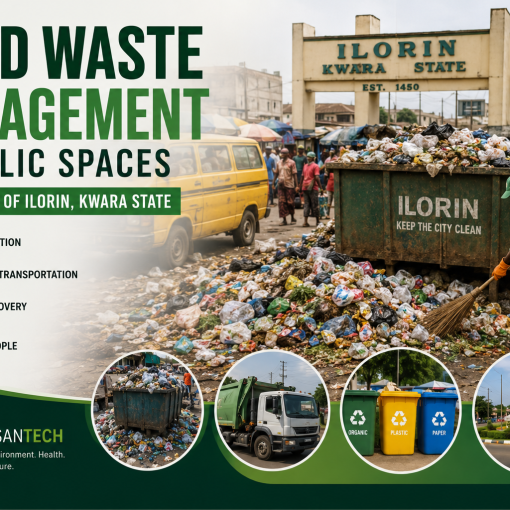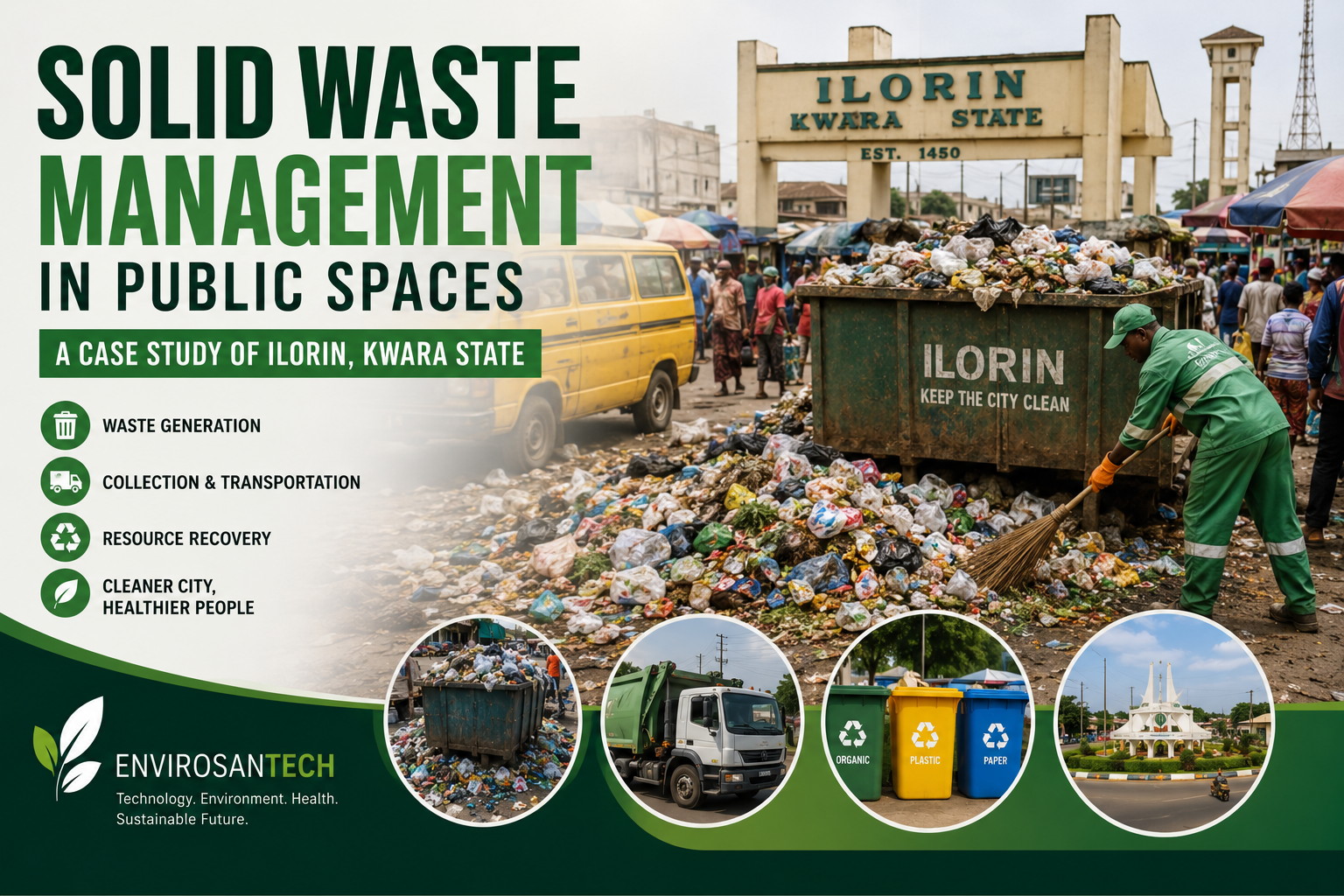
In the previous article, we looked at solid waste management in public spaces and how waste generated in places such as markets can become an environmental problem when it is poorly stored, collected or disposed of. But waste is only one part of a much larger environmental sanitation system.
What happens when human activities begin to affect a river?
For communities in and around Ilorin, Kwara State, the Asa River provides an important local example. Rivers can receive runoff, wastewater and pollutants from surrounding human activities. Understanding what is happening to a water body therefore requires more than simply looking at the colour of the water. It requires environmental monitoring, sampling, laboratory analysis and interpretation of results.
This is one of the areas where environmental sanitation technology becomes particularly important.
Water Quality Is More Than Appearance
One of the lessons I have gained from studying Environmental Health Science is that environmental conditions cannot always be judged accurately with our eyes.
Water may appear clear and still contain microorganisms or chemical contaminants. Conversely, water that looks cloudy does not automatically tell us exactly which contaminant is responsible.
This is why environmental health professionals use water-quality parameters and laboratory methods to investigate possible hazards.
Common parameters include pH, temperature, turbidity, electrical conductivity, dissolved oxygen, biochemical oxygen demand and microbiological indicators. Depending on the purpose of the investigation, additional chemical contaminants may also be tested.
A review of water-quality monitoring in Nigeria emphasized the importance of systematic assessment because water-quality problems can involve physical, chemical and biological characteristics (Ighalo & Adeniyi, 2020).
For an environmental health student, this changes the way one looks at a river. Instead of asking only, “Does this water look clean?”, the better question becomes, “What does the evidence tell us about its quality and possible uses?”
The Asa River Case Study
A useful example comes from research conducted around the Amilengbe area of Ilorin.
A 2022 study investigated the effects of human activities on the water quality of the Asa River. The researchers selected two sampling points, one upstream and another downstream, and collected 16 water samples over four months. Temperature was measured in the field, while other physicochemical and microbiological parameters were analyzed in the laboratory (Adebayo et al., 2022).
The study found evidence of pollution associated with human activities in the area. Several water-quality parameters were significantly higher downstream than upstream, although some parameters showed the opposite pattern. The researchers concluded that increasing human activities and urbanization around the river required monitoring because of their potential effects on water quality (Adebayo et al., 2022).
Importantly, the researchers did not simply declare the river “dirty.” They used sampling, laboratory testing, statistical analysis and a Water Quality Index (WQI) to reach their conclusions.
That is environmental sanitation technology in action.
Why Upstream and Downstream Matter
The decision to compare upstream and downstream locations is particularly useful.
Imagine a river flowing through an area where several human activities occur along its banks. If water is sampled before the area and again after passing through it, the two locations can be compared.
If substantial differences occur, investigators can begin asking what activities between the two points could have contributed to those changes.
This does not automatically prove that one particular activity caused a change. Other factors may also be involved. That is why environmental investigations require careful sampling designs, appropriate laboratory procedures and statistical analysis.
This scientific approach is something my Environmental Health Science training has reinforced for me. During academic practicals and project work, I learned that environmental-health investigations should be based on evidence rather than assumptions.
A professional should be able to explain how a conclusion was reached.
What Technology Adds to Water Monitoring
Traditional water-quality assessment can involve collecting samples and transporting them to a laboratory for analysis. This remains extremely important, but technology is creating additional possibilities.
Portable meters can allow certain parameters to be measured directly in the field. GPS devices can record sampling locations. GIS can then be used to map those locations and examine their relationship with land use, settlements, drainage systems and potential pollution sources.
Digital records can also make it easier to compare results from different locations and different periods.
More recently, researchers at the University of Ilorin demonstrated how Internet of Things (IoT) technology could be applied to water-quality monitoring. A solar-powered monitoring system was deployed at the University of Ilorin Water Treatment Plant and collected time-stamped measurements of parameters including pH, turbidity, temperature, oxidation-reduction potential, electrical conductivity and total dissolved solids (Adeniyi et al., 2025).
The study demonstrates an important direction for environmental sanitation: moving from occasional measurements toward systems capable of providing more continuous information.
A Personal Lesson From Environmental Health Training
My experience in Environmental Health Science has made me appreciate the difference between simply identifying an environmental problem and properly investigating it.
Classroom teaching introduces the principles, but practical training, SIWES and research help connect those principles to real environments.
When studying an environmental problem, there are questions that naturally follow:
Where is the problem occurring?
What is causing it?
Who or what is being exposed?
How serious is the risk?
What evidence supports the conclusion?
And what intervention is realistic?
These questions are useful whether the subject is waste, water, noise, sanitation facilities or pollution.
The influence of my lecturers, including the late Professor Henry Sawyer, was part of the academic foundation that helped me understand environmental health as a discipline requiring scientific reasoning and practical observation.
Why This Matters to Ilorin
The Asa River is not just a line on a map. It exists within an urban environment where people live, work, travel, farm and carry out commercial activities.
Research on the river demonstrates why environmental sanitation cannot be separated from urban development. As human activities increase around a water body, environmental monitoring becomes increasingly important.
Another study examining organochlorine pesticides and triclosan in soil, sediment and water from the Asa Dam River area of Ilorin further demonstrates the need to consider chemical contaminants when assessing environmental and potential health risks (Adeniyi et al., 2022).
This does not mean that every person who comes into contact with the river will become ill. Environmental health assessment requires understanding the type and concentration of contaminants, exposure pathways, duration of exposure and the intended use of the water.
That is why evidence matters.
From Monitoring to Prevention
Water-quality monitoring should not be treated as an activity that ends when laboratory results are produced.
The purpose of monitoring is ultimately to support action.
If a water body shows evidence of contamination, environmental professionals and relevant authorities need to investigate possible sources and determine appropriate interventions. These could include controlling wastewater discharge, improving sanitation facilities, managing solid waste, protecting riverbanks, educating communities and enforcing environmental regulations.
The Asa River study recommended monitoring human activities around the study area because urbanization was increasing and could contribute to further pollution (Adebayo et al., 2022).
This is an important principle: prevention is better than waiting until environmental damage becomes severe.
Conclusion
The Asa River provides a valuable Nigerian example of why environmental sanitation technology matters.
Water-quality problems cannot always be identified by looking at water. They require sampling, measurement, laboratory analysis, statistical interpretation and, increasingly, digital monitoring technologies.
For me, studying Environmental Health Science has reinforced the importance of approaching environmental problems scientifically. My classroom education, practical exposure, SIWES and project experience have all contributed to this understanding.
The lesson from Ilorin is straightforward: as human activities expand, environmental monitoring must expand with them.
Technology gives environmental health professionals better tools to understand what is happening, but those tools must ultimately support prevention, responsible development and protection of public health.
The future of environmental sanitation is therefore not simply about cleaning up environmental problems after they occur. It is about detecting risks early, understanding their causes and using evidence and technology to prevent them from becoming larger problems.
References
Adebayo, A. A., et al. (2022). Assessment of anthropogenic activities impacts on the water quality of Asa river: A case study of Amilengbe area, Ilorin, Kwara state, Nigeria. Environmental Challenges, 7, 100473.
Adeniyi, A. G., et al. (2025). Harnessing IoT and advanced analytics for sustainable water quality management. Water-Energy Nexus, 8, 287–299.
Adeniyi, A. G., et al. (2022). Evaluating the fate and potential health risks of organochlorine pesticides and triclosan in soil, sediment, and water from Asa Dam River, Ilorin Kwara State, Nigeria.
Ighalo, J. O., & Adeniyi, A. G. (2020). A comprehensive review of water quality monitoring and assessment in Nigeria. Chemosphere, 260, 127569.