In the first three articles, we moved from the general idea of environmental sanitation technology to practical problems involving waste management and water-quality monitoring. This time, the focus moves closer to something every household needs: safe water.
Water looks simple. We drink it, cook with it, bathe with it, wash with it and use it for many everyday activities. But behind every safe water supply is a chain of activities involving water sources, infrastructure, treatment, testing, monitoring and public health.
My SIWES experience at the Kwara State Rural Water Supply and Sanitation Agency (RUWASSA) gave me a closer understanding of this connection. As an Environmental Health Science student, spending time within an organization concerned with rural water supply and sanitation helped connect some of the things I had learned in class with the practical responsibilities involved in protecting communities.
Water Is a Public-Health Issue
Safe water is not simply a matter of convenience. It is a fundamental public-health requirement.
The World Health Organization identifies contaminated drinking water as an important route for diseases including diarrhoea, cholera, dysentery, typhoid and polio (WHO, 2023). Safe water is also important for hygiene, food preparation and other activities that reduce exposure to disease.
WHO’s current drinking-water guidance emphasizes a risk-management approach that considers the entire system, from the water source through treatment and distribution to the consumer (WHO, 2026).
This is an important idea because water can become contaminated at different points.
A protected source can still be affected by poor handling. A properly treated supply can be recontaminated during transportation or storage. A clean container can become contaminated when it is handled incorrectly.
Safe water therefore requires more than simply finding a water source.
What RUWASSA Does
The work of RUWASSA provides a useful example of how water supply and environmental sanitation are connected in Kwara State.
Under the Kwara State Rural Water Supply and Sanitation Agency Law, RUWASSA has responsibilities that include planning, implementing, monitoring and evaluating rural water and sanitation activities. Its functions also include increasing access to safe drinking water, carrying out bacteriological and chemical testing of boreholes, treating bacteriologically contaminated boreholes and investigating pollution pathways that may affect water used by communities (Kwara State Government, 2006).
This immediately shows why environmental health and water technology cannot be separated.
A borehole is not automatically a safe source simply because water comes out of it.
The source needs to be properly constructed, protected and monitored. Where necessary, water quality needs to be tested to determine whether it is suitable for its intended use.
My SIWES Experience
My SIWES at RUWASSA was one of the experiences that helped me understand this more practically.
University education provides the scientific foundation, but SIWES creates an opportunity to see how professional responsibilities operate outside the classroom. Concepts that can seem theoretical during lectures become easier to understand when they are connected to actual environmental-health work.
For me, the experience reinforced the idea that environmental health is not only about responding to problems after they occur. It is also about prevention.
A major part of professional thinking is asking questions before a problem becomes a health emergency.
Where does the water come from?
Is the source protected?
Could nearby activities introduce contamination?
How is the water handled?
Has its quality been tested?
What happens if contamination is detected?
These questions are central to protecting drinking-water supplies.
Water Testing: Looking Beyond What the Eye Can See
One of the most important lessons in water sanitation is that appearance is not enough.
Clear water may still contain microorganisms or chemicals that cannot be detected simply by looking at it. WHO identifies microbial contamination from faecal sources as one of the greatest risks to drinking-water safety (WHO, 2023).
This is why water-quality testing is important.
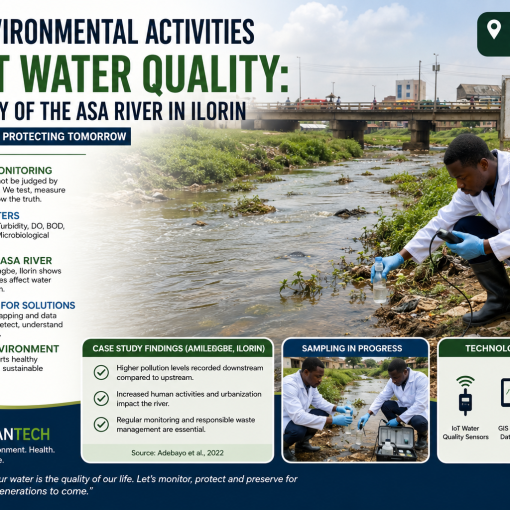
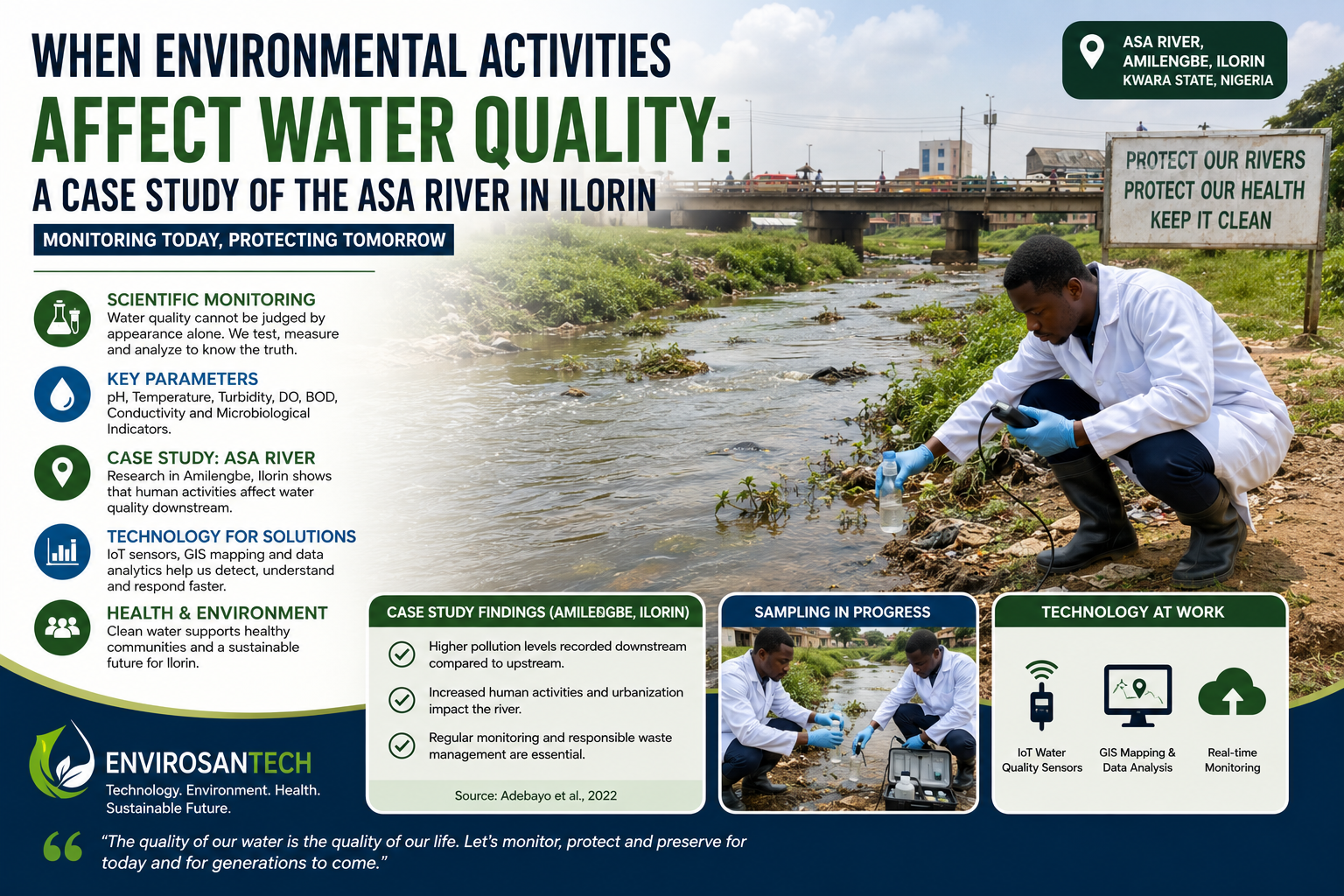
Depending on the purpose of an investigation, professionals may examine physical, chemical and microbiological characteristics of water. Parameters can include pH, turbidity, temperature, electrical conductivity, total dissolved solids and microbiological indicators.
Kwara’s own budget documents have also specifically included funding for water analysis for RUWASSA, demonstrating that water-quality assessment is part of the agency’s operational responsibilities (Kwara State Government, 2020).
For an Environmental Health Science student, this reinforces an important principle: environmental decisions should be based on evidence.
Technology and Water Safety
Technology has an important role in making water monitoring more effective.
Traditional water-quality assessment may involve collecting samples and taking them to a laboratory. Today, portable meters and digital instruments can allow some parameters to be measured directly in the field.
GPS and GIS can also be used to record and map water points. Digital databases can help authorities maintain information about boreholes, locations, test results and maintenance activities.
The importance of this type of technology can be seen in water-monitoring approaches elsewhere in Nigeria. WHO’s recent guidance describes Nigeria’s 2023 rural drinking-water monitoring framework as using a risk-based approach in which higher-risk sites receive more frequent surveillance. It includes sanitary inspections and water-quality testing of rural water supplies during both rainy and dry seasons (WHO, 2025).
This approach makes sense because environmental risks are not necessarily constant throughout the year.
The Nigerian Reality
Water supply challenges in Nigeria are not identical everywhere.
Some communities depend on boreholes, others on wells, rivers, streams, rainwater or public water systems. The quality and reliability of these sources can vary.
WHO’s 2023 data show that Nigeria still had substantial gaps in access to safely managed drinking-water services, demonstrating that improving water safety remains an important national challenge (WHO & UNICEF, 2025).
For rural communities, the challenge can be even more complicated because distance, infrastructure, maintenance, electricity, funding and technical capacity can affect whether a water facility remains functional.
This is why simply constructing more water points is not enough.
A sustainable water programme must also consider maintenance, monitoring, community participation and long-term management.
From Water Source to Household
One of the most important things I have taken from my Environmental Health Science education and SIWES experience is that the safety of water should be considered as a chain.
It begins with the source.
The source needs protection from contamination. Infrastructure needs to be properly designed and maintained. Where treatment is required, it must be appropriate for the water and consistently operated. Water quality needs to be monitored, and users need to handle and store water safely.
Breaking any part of this chain can create a risk.
This is why WHO promotes Water Safety Plans, which use preventive risk management from catchment to consumer rather than waiting until contamination has already caused harm (WHO, 2026).
Why Environmental Health Professionals Matter
Environmental Health Science brings together many of these responsibilities.
Professionals need to understand environmental hazards, sanitation, water quality, health risks, community behaviour and preventive measures.
My classroom education, project work and SIWES experience have helped me appreciate that environmental health is a practical discipline. The late Professor Henry Sawyer was among the lecturers who contributed to my academic foundation, while practical experiences helped me understand how classroom knowledge can be applied to real environmental problems.
The lesson I take from my time at RUWASSA is that safe water does not happen by accident.
It requires planning, infrastructure, testing, monitoring, maintenance and people who understand the health consequences of failure.
Conclusion
Safe water is one of the clearest examples of environmental sanitation technology in practice.
From protecting water sources to testing boreholes, monitoring quality and maintaining infrastructure, every stage contributes to protecting public health.
My SIWES experience at RUWASSA in Kwara State helped me see the connection between what I learned as an Environmental Health Science student and the practical responsibilities involved in rural water supply and sanitation.
For Nigeria, the challenge is not only to increase access to water. We must also ensure that the water people receive is safe, reliable and properly managed.
Technology can help us achieve this through better testing equipment, digital records, GIS mapping, monitoring systems and improved water-treatment technologies.
But technology works best when combined with professional expertise, responsible management and community participation.
Ultimately, the journey from a water source to a household is also a journey of public-health protection—and environmental sanitation professionals have an important role to play at every stage.
References
Kwara State Government. (2006). Kwara State Rural Water Supply and Sanitation Agency Law, No. 2 of 2006. Kwara State Government.
Kwara State Government. (2020). Kwara State Estimates, 2020. Kwara State Government.
World Health Organization (WHO). (2023). Drinking-water. World Health Organization.
World Health Organization (WHO). (2025). Guidelines for drinking-water quality: Small water supplies. World Health Organization.
World Health Organization (WHO). (2026). Drinking-water quality guidelines. World Health Organization.
World Health Organization (WHO) & UNICEF. (2025). Progress on household drinking water, sanitation and hygiene 2000–2024: Special focus on inequalities. WHO/UNICEF Joint Monitoring Programme.
Read about Sanitary Inspection of Boreholes here..