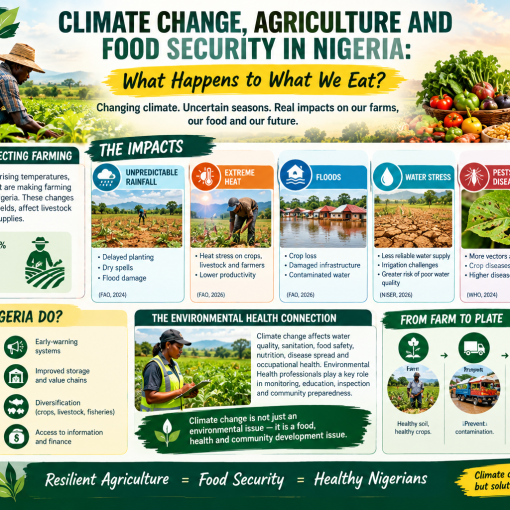
Agriculture feeds communities, supports livelihoods and provides raw materials, but farming can also create environmental problems when chemicals, waste and land-management practices are poorly controlled.
In Environmental Health Science at Kwara State University, I have learnt that an agricultural activity should not be considered only from the perspective of food production. We also have to consider what happens to the soil, water, air, farmers, consumers and other organisms that share the environment.
Agricultural pollution occurs when farming activities introduce substances or wastes into the environment at levels that can cause harm. Fertilizers, pesticides, herbicides, animal waste, agricultural plastics and sediment carried by runoff can all contribute.
For someone studying Environmental Health in Kwara State, this subject is particularly relevant because agriculture takes place around us, while Ilorin and surrounding communities depend on land and water resources for different purposes.
Fertilizers: Useful but Not Risk-Free
Fertilizers are important because crops need nutrients such as nitrogen, phosphorus and potassium. The problem begins when fertilizers are applied excessively or when rainfall carries nutrients away from the field.
During rainfall, dissolved nutrients can move with surface runoff into streams, ponds and rivers. Some can also infiltrate the soil and potentially reach groundwater.
A study carried out at the University of Ilorin Teaching and Research Farm and the National Centre for Agricultural Mechanization (NCAM), Idofian, examined how different tillage practices affected surface runoff and water pollution. The researchers used experimental plots during maize-growing seasons and analysed runoff from different tillage treatments (Agaja, 2025).
This local study is useful because it shows that agricultural pollution is not an abstract problem. It can be investigated within agricultural environments in Kwara State.
Pesticides and Herbicides
Pesticides help farmers control insects, fungi and other pests, while herbicides are used to control unwanted plants. Without proper use, however, these chemicals can become environmental contaminants.
One concern is spray drift. During application, droplets can move beyond the intended crop area. Another is runoff, where rainfall transports chemicals from farmland into nearby water bodies.
A study conducted at NCAM Farm in Ilorin specifically examined agrochemicals in runoff and at the soil interface. The researchers investigated fields treated with NPK fertilizer, urea fertilizer, organochlorine pesticides and glyphosate herbicide, showing how agrochemical substances can move along runoff pathways (Akande, 2024).
This is an important environmental-health lesson: applying a chemical to a farm does not mean its movement stops at the farm boundary.
What We Are Taught at KWASU
One of the things Environmental Health teaches me is to think in terms of hazard, exposure and risk.
A chemical may be hazardous, but the risk depends on factors such as concentration, duration of exposure, route of exposure and the people involved.
For farmers, exposure can occur during mixing, spraying, equipment cleaning or handling treated crops. For the wider population, exposure can occur through contaminated food, water or environmental media.
This is why personal protective equipment, correct application rates, proper storage and safe disposal are important.
A 2026 study involving farmers in Ilorin reported the use of several agrochemicals and found that some participants experienced symptoms including skin irritation and respiratory problems. The researchers also reported an association between PPE use and reduced exposure, while identifying continuing gaps in safety knowledge and practice.
This local evidence reinforces something we are taught repeatedly: prevention is better than waiting for an occupational exposure to produce a serious health problem.
What I Notice During Field Learning
Field activities have also taught me to look at agricultural environments beyond the crops themselves.
A farm is connected to its surroundings. There may be drainage channels, streams, wells, boreholes, livestock areas, homes and roads nearby.
If chemicals or animal waste are poorly managed, rain can transport contaminants away from the original source.
This is why an environmental health professional should not inspect an agricultural environment by looking only at whether crops are growing well.
The questions should include:
How are chemicals stored?
Where are empty pesticide containers taken?
How is agricultural waste handled?
Is runoff controlled?
Are workers using appropriate protective equipment?
Are water sources protected?
These questions help identify hazards before they become larger problems.
Agricultural Waste Is Also Part of the Problem
Pollution from agriculture is not limited to chemicals.
Animal manure, crop residues, spoiled produce, plastic materials, fertilizer bags, pesticide containers and other agricultural materials can become waste.
When organic agricultural waste is left unmanaged, decomposition can produce unpleasant odours and attract flies and other vectors. If waste is burned, it can contribute to air pollution. If it is dumped near waterways, it can contribute to water-quality problems.
The correct approach depends on the type of waste.
Some organic materials can be composted or appropriately returned to the soil. Some plastics can be recovered for recycling. Chemical containers require much greater caution and should not be casually reused for food or water.
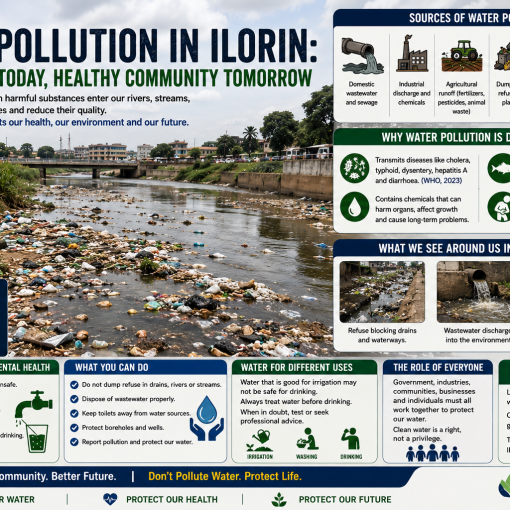
Agriculture and Water Pollution
The relationship between agriculture and water is especially important in Kwara State.
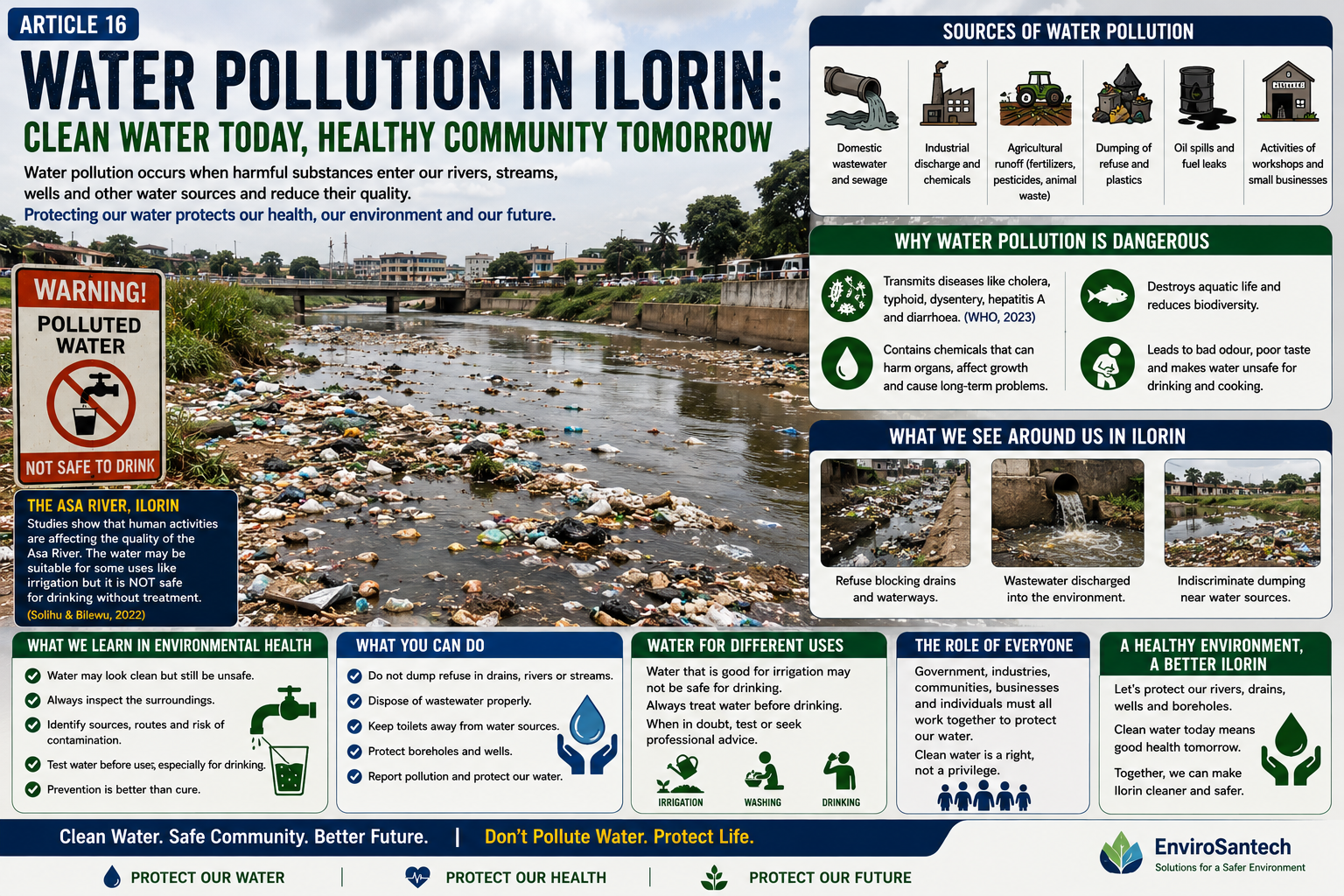
A study of the Asa River in Ilorin found evidence that human activities affected water quality and recommended measures including regular monitoring, improved sanitation and limited application of agrochemicals (Solihu & Bilewu, 2022).
Another study specifically investigated organochlorine pesticides and triclosan in soil, sediment and water along the Asa Dam River in Ilorin. The researchers detected organochlorine pesticide residues in the sampled environmental media, demonstrating why agricultural chemicals deserve attention even after application (Orosun et al., 2022).
This does not mean that every farmer using a pesticide is automatically polluting a river. The actual risk depends on the chemical, amount, application method, environmental conditions and pathway to the water body.
The important point is that the pathway exists and should be managed.
How Can Agricultural Pollution Be Reduced?
The first step is proper chemical use.
Farmers should use approved products and follow label instructions, recommended doses and application intervals.
Chemicals should be stored securely away from food, children, animals and water sources.
Farmers should also use appropriate PPE when handling pesticides and herbicides.
Integrated pest management can reduce dependence on chemical pesticides by combining methods such as crop rotation, biological control and other appropriate practices.
Good land management is also important. Vegetative cover, appropriate tillage and measures that reduce runoff can help limit the movement of soil and dissolved pollutants.
At the regulatory level, Nigeria has the National Environmental (Chemicals and Pesticides) Regulations, 2023. NESREA states that the regulations are intended to protect human health and the environment from harmful effects of hazardous chemicals, pesticides and other agrochemicals while supporting sustainable agriculture.
Why This Matters to Ilorin
Agricultural pollution can easily become an issue beyond the farm.
A farmer may apply a chemical to protect crops, but if that chemical enters runoff, it can travel into another environmental compartment.
A fertilizer applied to improve crop growth can become a water-quality problem if excessive nutrients are washed away.
A pesticide container thrown beside a farm can become a waste-management problem.
Animal waste dumped into a stream can become a sanitation and water-quality problem.
This is why Environmental Health looks at the whole environmental system.
Agriculture Should Not Create Another Environmental Problem
Agriculture and environmental protection do not have to be enemies.
Farmers need fertilizers, pesticides and other inputs to protect crops and improve production, but these materials must be used responsibly.
My training at KWASU has taught me that environmental health is fundamentally preventive. My field learning has reinforced the importance of looking beyond the immediate activity and asking where its wastes, chemicals and other by-products eventually go.
Research around Ilorin and other parts of Nigeria shows that agrochemicals can move through soil and runoff and that pesticide exposure deserves attention.
The goal is therefore not to stop farming.
It is to make farming safer for farmers, consumers and the environment.
If the soil is protected, water is protected and farmers are protected, agriculture becomes more sustainable.
Good farming should produce food without creating another environmental problem in the process.
References
- Agaja, T. M. (2025). Water Quality and Tillage Practices for Sustainable Agricultural Development in a Guinea Savanna Ecological Zone, Kwara State, Nigeria. FUDMA Journal of Earth and Environmental Sciences.
- Akande, F. B. (2024). Concentration Weathering of Some Agrochemicals in Runoff and Soil Interface on the National Centre for Agricultural Mechanization (NCAM) Farm, Ilorin, Nigeria. Journal of Agriculture and Ecology Research International.
- Solihu, H., & Bilewu, S. O. (2022). Assessment of anthropogenic activities impacts on the water quality of Asa River: A case study of Amilengbe area, Ilorin, Kwara State, Nigeria. Environmental Challenges, 7, 100473.
- Orosun, M. M., et al. (2022). Evaluating the fate and potential health risks of organochlorine pesticides and triclosan in soil, sediment, and water from Asa Dam River, Ilorin Kwara State, Nigeria.
- Al-Hikmah University researchers. (2026). Assessment of Occupational Exposure to Carcinogenic Agrochemicals Among Farmers in Ilorin Metropolis, Kwara State, Nigeria. Al-Hikmah Journal of Health Sciences.
- National Environmental Standards and Regulations Enforcement Agency (NESREA). National Environmental (Chemicals and Pesticides) Regulations, 2023.