During my training in Environmental Health Science, one lesson became increasingly clear to me: the environment we live in can determine the health problems we face. The late Professor Henry Sawyer often emphasized the importance of understanding the relationship between environmental conditions and human health. Today, climate change makes that relationship even more important.
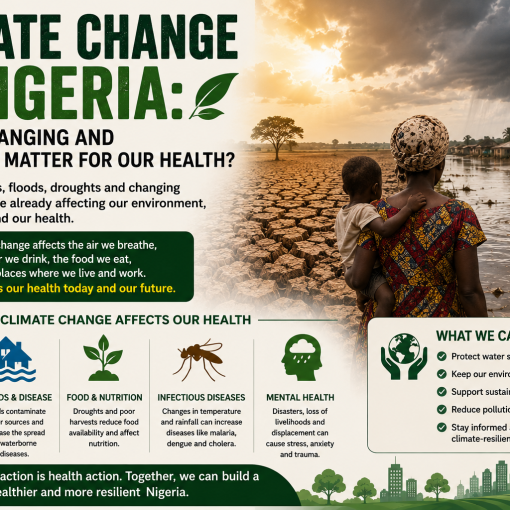
Climate change may sound like a global issue discussed at international conferences, but its effects can be seen much closer to home. In Ilorin and across Kwara State, changing rainfall patterns, flooding, increasing heat, water insecurity and pressure on agriculture are environmental-health concerns that deserve serious attention.
Kwara Is Already Experiencing Climate Risks
Kwara State Government has acknowledged changes in rainfall patterns and extreme weather, linking these trends partly to climate change. The state has also identified measures such as drainage desilting, waste management, tree planting and flood-control interventions as important adaptation measures (Kwara State Government, 2022).
Kwara’s geographical position also matters. The state contains communities that depend heavily on agriculture and natural water resources. Its environmental challenges include flooding, erosion, changing rainfall patterns, drought and inadequate access to water in some areas (ACReSAL, 2026).
This means climate change in Kwara should not be viewed only as a future problem. It is already connected to the way communities live, work, farm and obtain water.
1. Heat: A Growing Health Concern
Anyone who has spent time outdoors in Ilorin knows how intense the heat can feel, particularly during the dry season. For people working outdoors—farmers, construction workers, street traders, environmental workers, transport workers and others—high temperatures can become more than an inconvenience.
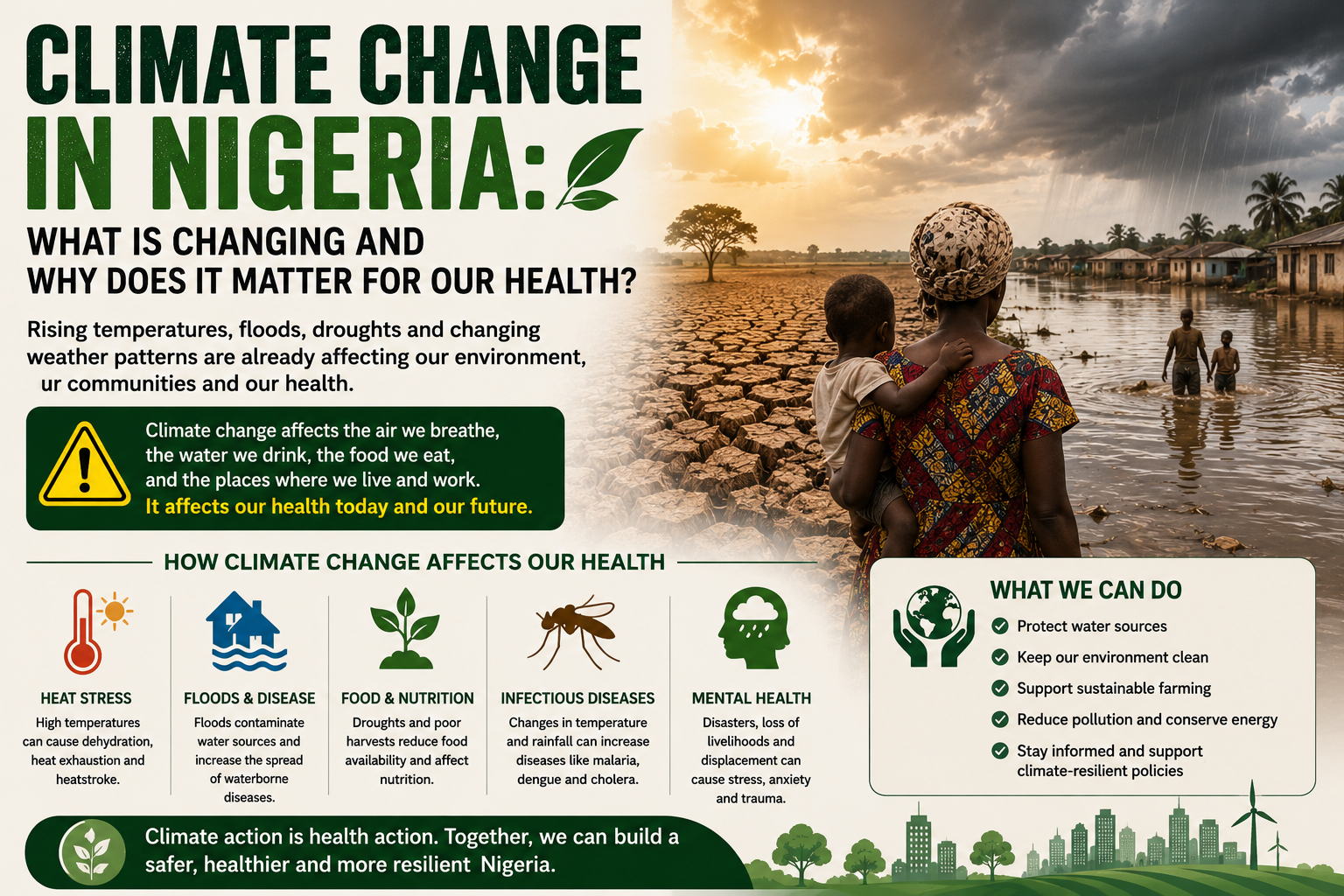
Heat exposure can cause dehydration, heat exhaustion and heatstroke. It can also worsen existing cardiovascular, respiratory and other health conditions. WHO now recognizes heat as an important environmental and occupational health hazard (WHO, 2026).
Urban development can make the problem worse. Concrete buildings, roads and other surfaces absorb and retain heat, while limited vegetation can reduce natural cooling.
For an Environmental Health professional, this raises practical questions: Are outdoor workers receiving adequate information about heat? Is drinking water readily available? Are workplaces providing appropriate rest periods? Are vulnerable people being considered during periods of extreme heat?
These questions turn climate change into an everyday public-health issue.
2. Flooding and the Health of Ilorin Communities
Flooding is another important concern.
Heavy rainfall can overwhelm drainage systems, particularly where drains are blocked by refuse or where development has occurred too close to waterways. In 2022, NEMA documented flooding across parts of Kwara, including communities in Ilorin East and Asa Local Government Areas. Houses and farmlands were submerged, while people were displaced in some affected communities (NEMA, 2022).
Flooding is not simply about water entering homes.
Floodwater can carry sewage, refuse, animal waste and other contaminants into areas where people live. Wells and other water sources can become contaminated. Standing water can also create conditions favourable to mosquitoes and other disease vectors.
WHO notes that climate-related flooding can affect health through injuries, displacement, contaminated water, infectious diseases, disruption of healthcare services and mental-health consequences (WHO, 2024).
This is where environmental sanitation becomes extremely important.
3. Water Stress: Too Much Water and Too Little Water
One of the interesting contradictions of climate change is that the same community can experience flooding during one period and water scarcity during another.
Climate variability can affect the reliability of rainfall and water availability. In Kwara, recent research by NISER’s PALM-TREEs project identified water insecurity as a major constraint to climate resilience and reported that 57.4% of rural households studied lacked access to safe water (NISER, 2026).
When water becomes scarce, households may depend on less-protected sources. This can create additional risks if the water is not adequately treated.
From my Environmental Health training and field exposure, sanitary inspection has taught me that water safety does not end at the source. The condition of the source, collection container, transportation, storage and method of use can all influence whether water remains safe.
Climate-resilient water systems therefore need to be designed with both drought and flooding in mind.
4. Agriculture and Food Security in Kwara
Kwara’s economy and livelihoods are strongly connected to agriculture. However, agriculture depends heavily on predictable rainfall, suitable temperatures and adequate soil moisture.
Kwara’s agricultural planning documents identify changing temperature, rainfall variability, flooding and drought as factors that can affect agricultural productivity. Small-scale, rain-fed farmers are particularly vulnerable because they may have limited irrigation and other resources for adapting to climate shocks (Kwara State Government, 2020).
More recent research also identifies drought as a major climate risk to agricultural systems and rural livelihoods in Kwara, with reported crop losses, declining soil moisture and increasing rainfall variability (NISER, 2026).
When agricultural production is affected, the consequences can extend beyond farmers. Reduced production can influence food availability, household income and food prices.
Climate change can therefore become a food-security and public-health issue.
5. Climate Change and Disease
Climate conditions influence the environments in which disease vectors and pathogens survive.
Changes in temperature and rainfall can influence mosquitoes and other vectors, while flooding can increase exposure to contaminated water. WHO identifies climate change as a factor affecting vector-borne, water-borne and food-borne diseases (WHO, 2024).
This does not mean that every disease outbreak is caused by climate change. Rather, changing environmental conditions can modify existing risks.
Environmental Health Officers therefore have an important role in surveillance, sanitation, vector control, health education and community preparedness.
6. What Can We Do in Ilorin and Kwara?
Climate adaptation does not always require complicated technology.
At community level, important measures include:
- Keeping drains and waterways free from refuse.
- Avoiding construction on waterways and flood-prone areas.
- Protecting wells and other water sources from contamination.
- Improving waste management.
- Planting and protecting trees.
- Promoting water conservation.
- Supporting climate-smart agriculture and irrigation.
- Providing heat-safety information to outdoor workers.
- Strengthening flood early-warning systems.
- Improving community awareness of climate-related health risks.
Kwara State Government has specifically advised residents to avoid dumping refuse along waterways, maintain surrounding drainage, plant trees and comply with building approvals and flood warnings (Kwara State Government, 2022).
Recent NISER research also recommends stronger climate-risk governance and better access to early-warning information for communities in Kwara (NISER, 2026).
Climate Change Is a Kwara Health Issue
Climate change in Kwara is not only about temperature charts or rainfall statistics. It affects where people live, the water they drink, the food they produce, the work they do and the diseases they may face.
As Environmental Health professionals, we must therefore look beyond treating problems after they occur. Our work should include prevention, environmental monitoring, sanitation, health education, community preparedness and climate adaptation.
Ilorin and Kwara State cannot control the global climate alone. But we can control how prepared our communities are.
A cleaner drain, protected water source, properly planned settlement, healthy tree cover, informed farmer and prepared health worker may seem like small actions individually. Together, they form part of a more climate-resilient Kwara.
Climate change is global, but resilience begins locally.
References
- Kwara State Government. (2022). KWSG issues public advisory on climate change, flooding.
- Kwara State Government. (2020). Kwara Agricultural Transformation Plan 2020–2030.
- NEMA. (2022). Assessment of more communities affected by flood in Kwara State.
- NISER. (2026). Building Drought Resilient Agriculture and Livelihood Systems in Kwara State.
- NISER. (2026). Scaling Climate-Resilient Water Infrastructure for Productive Rural Economies in Kwara State.
- World Health Organization. (2024). Guidance on climate change and health.
- World Health Organization. (2026). Heat and health.